The adaptogen category is mostly a mess. Rhodiola, holy basil, eleuthero — you’ll find them all in supplement stacks, sometimes alongside breathless claims about “resilience” and “adrenal support,” usually without a single well-designed human trial behind them. The term “adaptogen” itself isn’t a medical or pharmacological classification. It’s a marketing concept dressed in Soviet-era research language, which is exactly where a lot of these compounds originated.
Ashwagandha is different. Not entirely different — the overclaiming is still rampant, the product quality varies enormously, and some of the most popular health claims are extrapolated from animal data that hasn’t cleanly translated to humans. But ashwagandha has randomized, double-blind, placebo-controlled trials. Multiple ones, on the specific outcomes people actually care about. That puts it in a different category from most of what gets sold alongside it.
The complication is that the safety picture got messier in 2023 and 2024, in ways that most wellness content hasn’t caught up to. So this is both a stronger story and a more nuanced one than the usual supplement coverage suggests.
What it is and why it might do anything at all
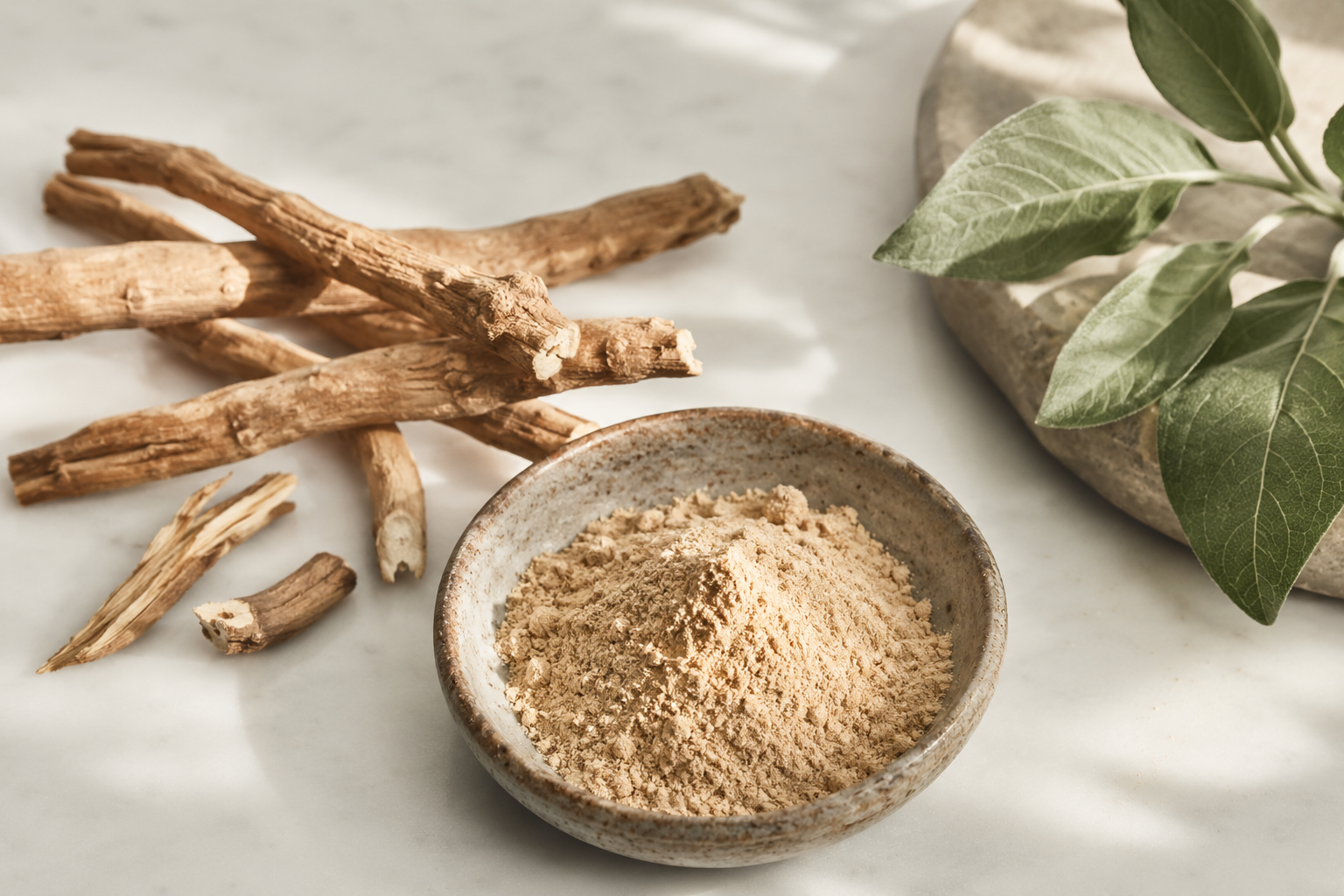
Ashwagandha — botanical name Withania somnifera — is a shrub in the nightshade family, native to India, North Africa, and parts of the Mediterranean. It’s been used in Ayurvedic medicine for thousands of years, primarily as a tonic and rejuvenating compound. The root is the part used in most modern research and supplements.
The active compounds are called withanolides — a class of steroidal lactones unique to the plant. Withanolides are the reason ashwagandha does anything at all in the body, and they’re also the reason some regulators started getting nervous. More on that shortly.
The leading mechanism researchers point to is modulation of the hypothalamic-pituitary-adrenal (HPA) axis — the brain-to-adrenal-gland signaling pathway that controls your cortisol response to stress. Ashwagandha appears to reduce the reactivity of this system over time, producing lower cortisol outputs in response to stressors. It also interacts with GABA receptors and may modulate serotonergic activity, which helps explain the anxiety-reduction and sleep effects. The exact molecular picture is still being worked out, but the stress-dampening mechanism is consistent across multiple study designs and measurement approaches.
The cortisol data
This is where the evidence base is strongest. A 2019 randomized, double-blind, placebo-controlled trial published in Medicine gave 300mg of KSM-66 extract twice daily to adults with chronic stress and found significant reductions in serum cortisol, alongside meaningful improvements on the Perceived Stress Scale. The cortisol reduction was around 22% compared to placebo over 60 days.
Multiple other trials using KSM-66 or Sensoril (another standardized extract) have found similar patterns — not dramatic cortisol crashes, but consistent, moderate reductions in stress-responsive cortisol over 8–12 week trials. A 2023 RCT in Medicine followed stressed adults for 60 days and found significant improvements in stress scores, anxiety measures, and quality of life. The effect sizes are real and consistently replicate.
Two things worth knowing about these studies: almost all of them use standardized extracts — KSM-66 (full-spectrum root extract) or Sensoril (root and leaf extract). The studies were not done on generic ashwagandha root powder, which is what most cheap supplements contain. The standardized extracts are guaranteed to contain a specific concentration of withanolides. Generic powder is not. This gap matters more than most supplement marketing acknowledges.
Testosterone and physical performance
This is where the data is real but also where the claims outrun it.
A 2023 study found that 600mg of KSM-66 daily significantly increased both free and total testosterone in men over 8 weeks, with reductions in serum creatine phosphokinase suggesting faster muscle recovery. An earlier trial found that ashwagandha supplementation alongside resistance training produced significantly greater gains in muscle strength and size compared to placebo plus training.
VO2 max improvements have also been documented. A double-blind, placebo-controlled study in healthy athletic adults found significant increases in VO2 max over 8 and 12 weeks with KSM-66 supplementation.
The mechanism here is probably indirect — lower cortisol reduces the catabolic, muscle-breaking environment that high chronic stress creates, and lower cortisol means the testosterone-to-cortisol ratio improves even without a direct testosterone stimulus. The direct androgenic effects are less established.
What the data doesn’t support: dramatic testosterone increases in men who aren’t under chronic stress, meaningful effects in healthy young men with normal baseline cortisol, or anything like the numbers you’d see from actual testosterone therapy. The effect is real, probably clinically meaningful for stressed men in midlife, and much smaller than the supplement marketing implies.
Sleep
A meta-analysis covering five randomized placebo-controlled trials in adults found that ashwagandha supplementation improved sleep quality across multiple validated measures: sleep onset latency, total sleep time, and next-morning mental alertness. The effect was more pronounced in people who already had some sleep difficulty compared to those sleeping normally.
The mechanism likely runs through the GABAergic pathway — withanolides interact with GABA-A receptors in a way that promotes a calming, sleep-conducive neurological state. This is the same general pathway as benzodiazepines, though with much weaker binding affinity and no meaningful risk of dependence at supplemental doses.
Doses across sleep studies have varied from 120mg of Shoden extract to 600mg of KSM-66. The lower doses of highly concentrated extracts appear to work comparably to higher doses of less concentrated forms.
The safety complication nobody is talking about
In 2023, Denmark became the first country in the EU to ban ashwagandha in food supplements. Several other EU countries have issued precautionary warnings. In 2024, the Dutch public health institute published a risk assessment noting potential adverse effects including liver injury and thyrotoxicosis. A working group of EU food safety authorities recommended ashwagandha be prioritized for an Article 8 safety assessment.
The specific concerns fall into three categories. First, potential thyroid effects: withanolides may stimulate thyroid hormone production, which is relevant for people with existing thyroid conditions or those taking thyroid medication. Second, liver toxicity: a number of case reports of ashwagandha-associated liver injury have emerged, most resolving on discontinuation, with suspected idiosyncratic mechanisms rather than predictable dose-dependent toxicity. The WHO’s global adverse event database had 15 reports of hepatobiliary disorders associated with ashwagandha as of late 2023. Third, historical traditional use as a uterotonic agent, raising questions about safety in pregnancy.
The counterpoint from researchers who have spent years studying the compound: the case reports of liver injury are extremely rare relative to the scale of consumption, no consistent toxicological pattern has been established, and most concerns stem from a 2020 Danish Technical University risk assessment that other researchers consider overly conservative. A 2025 computational safety analysis confirmed that ashwagandha root specifically showed no significant risk of hormonal disruption or thyroid toxicity in standard supplementation scenarios.
The honest position is: for most healthy adults taking standardized root extracts at studied doses (300–600mg KSM-66 daily) for periods up to 12 weeks, the risk profile appears low. The caveats are real: people with thyroid conditions should discuss with a physician first, pregnant women should avoid it, and anyone who develops unexplained nausea, jaundice, or fatigue should stop and get liver enzymes checked.
The product quality problem
A 2023 study of botanical athletic performance supplements found that 89% of products tested did not contain what their label claimed. That specific study didn’t cover ashwagandha, but there’s no reason to think ashwagandha is magically exempt from the quality problems that plague the broader supplement industry.
The practical implication: the clinical evidence for ashwagandha was generated almost entirely using KSM-66 or Sensoril — both trademarked, standardized extracts with verified withanolide content and published quality controls. Taking a generic “ashwagandha root 500mg” capsule from a random brand and expecting the same effects is not supported by the research. You’re probably getting the wrong extract form, at an unverified potency, without the quality controls the studies used.
KSM-66 products are broadly available and not particularly expensive. Sensoril is also widely licensed. There’s no reason to buy the unstandardized version unless the goal is saving a few dollars on something that may not work.
The actual bottom line
Ashwagandha is the most evidence-backed adaptogen available. The cortisol research is consistent and replicates across multiple high-quality trials. The sleep and testosterone effects are real, if more modest than commonly marketed. The mechanism is reasonably well understood.
The safety picture is more complicated than it was two years ago. The EU regulatory activity doesn’t mean the compound is dangerous, but it means the historical assumption of complete safety isn’t as solid as the traditional use history suggested. For most healthy adults, short-term use of standardized extracts at studied doses looks fine. For people with thyroid issues, liver conditions, or anyone taking medications that interact with adrenal or thyroid function, it warrants a conversation with a doctor first.
The version that actually works: KSM-66 at 300–600mg daily, taken consistently for at least 8 weeks, with food. Not the generic powder. Not the “proprietary blend.” The standardized extract the research actually used.
Leave a Reply